

is culinary school worth it?
honest reflections about my own experience

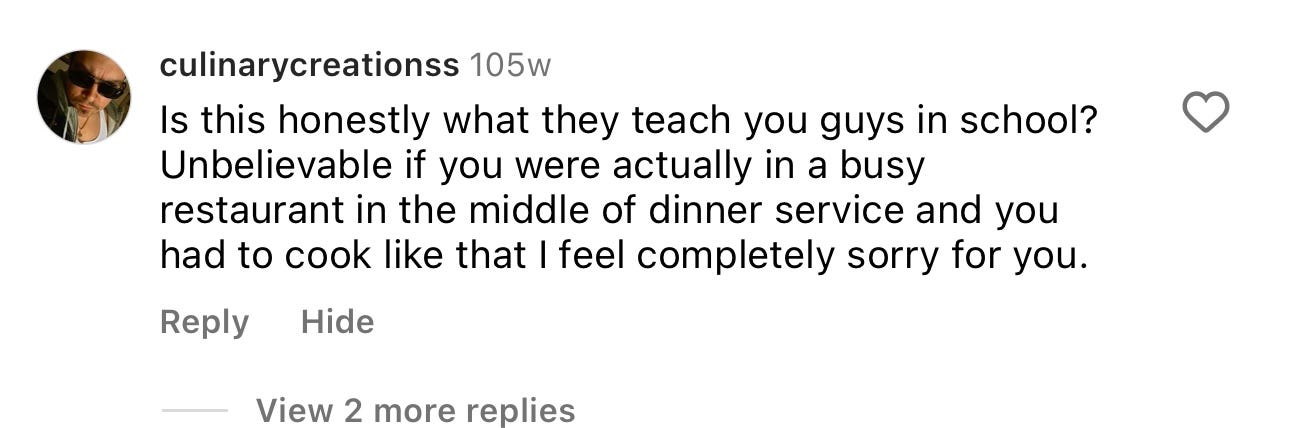
is culinary school worth it? depends on who you ask. and what you’re goals are after you finish.
I ‘vlogged’ my way through school, posting daily videos of our lessons and in doing so I amassed a following of 130k on instagram upon graduating. The combination of this online ‘resume’ and my program certificate helped me land a full-time private cheffing job almost immediately after finishing my externship. I’d say culinary school was worth it for me.
But, social media aside (because that was never the point of going to school), I have a lot of thoughts about the upfront investment of school and both the tangible skills and intangible benefits it delivers (and does not deliver).
allow me to set the stage
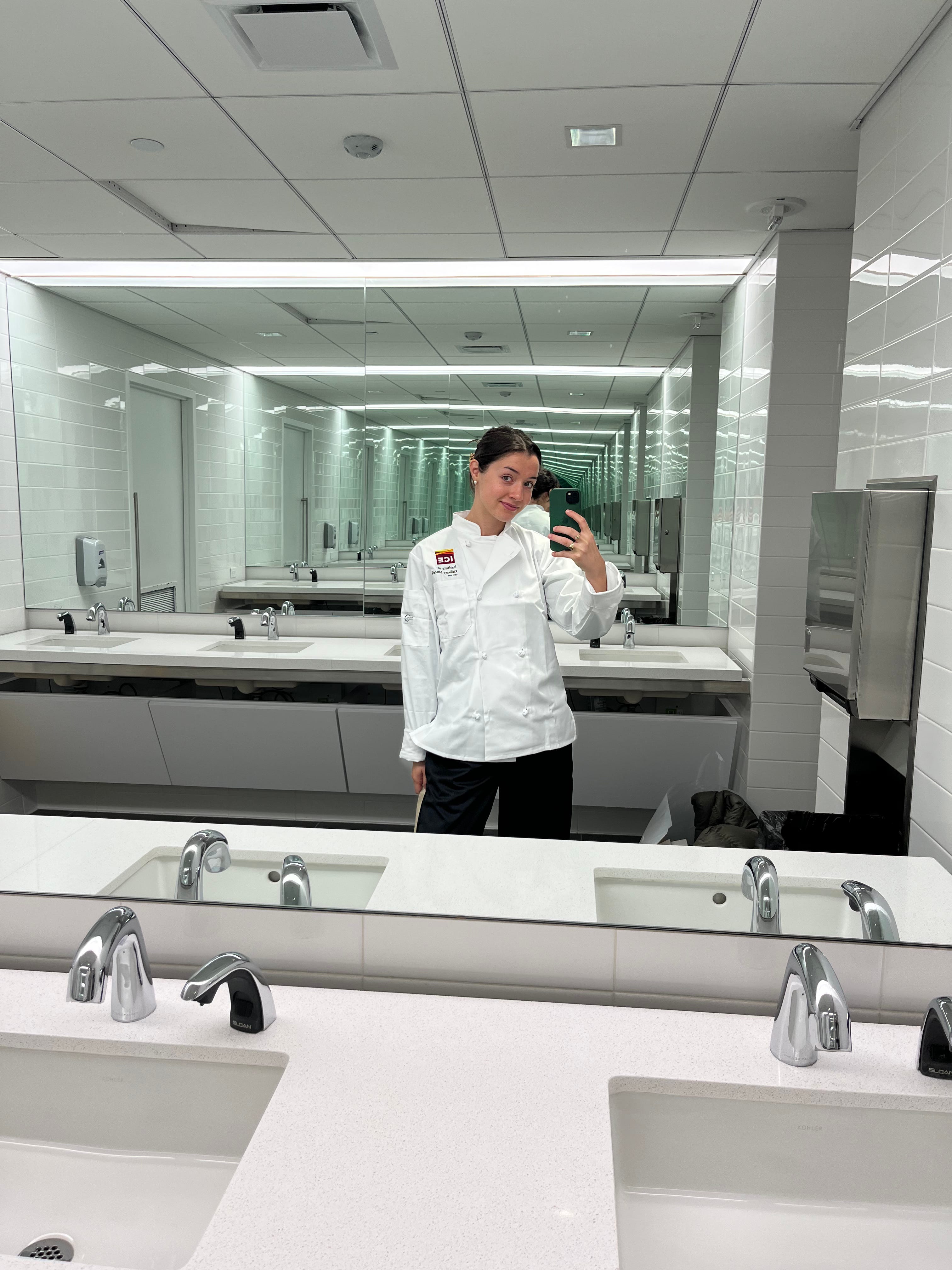
I attended the Institute of Culinary Education (ICE) in NYC from November 2022 to July 2023 as a student of the 8 month Culinary Arts Program (6 months of class, two months at an externship). As fate would have it, I lived directly next to the school in Battery Park and attended from 7- 11 am, Monday through Friday. This schedule worked beautifully because shortly after enrolling in school I landed a part-time job at the Dinex Group where I ran Chef Daniel Boulud’s social media account and spent my 2- 8 pm (sometimes 9…or 10… or 11pm) chasing him (literally) around the city between all of his restaurants and different events… a story I’ll have to share another time.


it was always ICE or nowhere
ICE was the only culinary school I considered because
1) I wanted to stay living in NYC while going to school
2) I wanted a program that would give me a certificate within a year
With these considerations, ICE was actually my only option. It was also a highly-reputable one. The school has been around for almost 50 years, and has essentially merged with or acquired all of the other culinary schools that existed at one point in NYC (most notably the International Culinary Center formerly known as the French Culinary Institute along with the Natural Gourmet Institute). ICE also touts a long list of alumni with successful careers across the food industry (from Mashama Bailey and Missy Robbins to Gail Simmons and Marc Murphy).
It’s for these same reasons that I never seriously considered the Culinary Institute of America– based in upstate NY and also a multi-year program. (I should note that ICE is a certificate program, not a degree bearing program like CIA)
my decision to enroll
In July 2022, after two years of post graduate life working for a global health focused non profit, I decided to quit my job. The one silver lining of graduating college in 2020 as the world was imploding thanks to Covid was that I promptly moved home, worked remotely, and saved every measly pay-check I earned because there was nowhere to go and nothing to do. Spring 2020 was also when I created my account on instagram, handmethefork, to document everything I was cooking and eating outside of work.
I managed to save enough in those 2 years that quitting my job, subletting the room in my apartment, and spending the rest of the summer on a small agriturismo in Tuscany helping with a cookbook project was not entirely reckless (my parents might tell a different story). I came back at the end of September riding the high of a magical summer and knowing I wanted to pursue ‘food,’ at least in some capacity, as my career. After a month of research and networking calls with anyone and everyone I could get on the phone who had careers even tangentially related to the food industry, I decided that enrolling in culinary school was the best next step.
Spoiler, I knew I didn’t want to work in a restaurant after. I thought private cheffing sounded exciting, though I doubted the likelihood I could find a job without years of restaurant experience. I was also intrigued by food media and test kitchens, and a job at Food52 or Bon Appetit sounded like a dream. Despite not having an extremely clear, tailored vision of my post culinary school career… I believed that school was the best way to get my foot in the door of the food industry and successfully pivot my career.
investing in culinary school
there are two major investments when it comes to culinary school: money and time.
School is not cheap. My 8 month program cost just around $42.5k. According to the fees listed on the website today, the tuition today for the same program is around $44k. You might be thinking ‘what could you possibly learn in school worth that much that’s not already available for free on youtube or working at a job as a line cook…. with emphasis on job, meaning you would be making money while learning.’ I got the ‘culinary school is a waste of money’ comment often. We’re gonna unpack that more later on.
School requires your time, the only truly finite resource we have! Whether going to culinary school means quitting your day job, scaling back to part-time, rushing to school after your 9-5 for the truly testing 7-11 pm class (much respect to you people), OR giving up your weekends for the Saturday/Sunday course… it’s a sacrifice or commitment in some way.
the tangible and intangible things I gained from school
so given these two investments, what did I takeaway from school? in coming up with a list of things I either learned from school or gained because of school, I realized that everything fell into one of two different categories:
1) the tangible skills learned
2) the intangible benefits of school, and, ICE, at large
In terms of the tangible skills learned, I found the curriculum as comprehensive as it could have been for a 6 month course. The first few modules were highly instructional and focused on technique, and I found these to be some of the most useful classes of the whole curriculum. things like fabrication and how to break down a whole fish or chicken or debone a pork shoulder. Or how I’d been holding a knife wrong my entire life and learning knife skills, that, over the course of the program (and repetition of 4 hour daily classes), I become proficient and efficient in.


When we actually started to cook, I also found the lessons that took us through the foundational cooking techniques most useful. Nailing the fundamentals of dry heat (sauteeing, frying, grilling) and moist heat (braising, stewing, steaming, poaching, and boiling) cooking gave me a confident foundation that I’ve found useful in recipe development and private cheffing. It gave me the base needed to never feel like I’m truly ‘flying blind’ in the kitchen… even when making a recipe I’ve never cooked before.
Intangibly, I gained discipline from showing up to the kitchen for 4 hours each weekday morning, cooking through multiple different recipes each day, and maintaining a clean station (which engrained the clean as you go mindset, ‘tidy station tidy mind’). I gained access to ICE career services which have relationships with most, if not all, of the best restaurants across NYC and boast a sizeable list of notable alumni. I gained the ability to add culinary school to my professional resume. And by documenting my experience on social media I grew my following from a little over 2k to over 120k in 4 months– the beginnings of a career on social media I could have never anticipated.
Lastly, I gained immense joy from the overall experience of attending culinary school itself. I’m someone who thrives in school and always held out on the pipe dream of one day going to culinary school, even if just as a personal endeavor. Attending school felt like a dream fulfilled and also the first step in pivoting my career to something I was incredibly excited and passionate about.


what lacked for me
Once the curriculum moved beyond the initial, highly instructional modules, I thought the format of the classes became less useful. The middle chunk of school focused on regional cooking from France and Italy and Germany to India and China and Japan (they’ve since expanded to include more cuisines, namely in Latin America, and I’m glad to hear it). The classes were structured to review the recipes for the day, divide into groups, delegate recipes amongst the group members, and cook them. I understand the goal was likely to begin to build agency in the kitchen with the instructor becoming more hands off, and expose us to different cuisines, but to me it just felt like showing up to class to follow a recipe. Something I could do at home.
I should also note that the wide spectrum of skill levels of people in my class took me by surprise and ranged from complete novice, to passionate home cook, to seasoned line cook and even junior sous chefs. This range in skill level sometimes made it difficult to work together in groups efficiently. Now maybe this is intentional (problem solving! working with different kinds of people! navigating group dynamics!), but I sometimes felt frustrated by how it contributed to slowing the pace of class. I came to school (and paid) to learn and grow and be challenged- and those middle courses didn’t deliver for me.


the go watch it on youtube argument
Now as great as all the tangible skills I mentioned above are, I won’t kid myself. All of it can be learned from youtube tutorials or websites (research reputable sources please) as long as you have the self-discipline and patience to effectively learn it yourself. You miss out on the in-person feedback… but in my experience the primary role of the chef instructor was to demonstrate technique. The days where we had practical exams (cooking tests) made up for the bulk of the feedback we received throughout school.
What you do miss out on is all of the intangible benefits I described above that go beyond skills learned in the kitchen. For me, the intangible benefits made up the bulk of why I consider culinary school ‘worth it’. I still had so much to learn after completing school, and the first few months of my private cheffing job felt like a second, more challenging culinary school as I figured out how to cook for a family full-time. But I was able to get that job, and keep my head enough above water during that steep learning curve, because of culinary school.
the go work in a restaurant argument
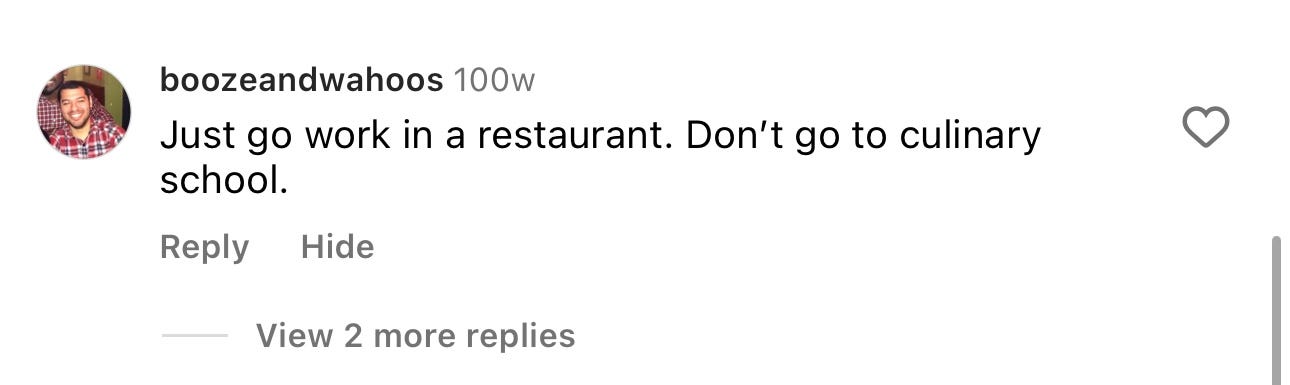
“Just go work in a restaurant where you’ll actually get paid to learn…” maybe, but it depends on what your goals are after school. If your goal is to work in restaurants and make your way up the ranks there…then yeah, you might be better off going straight to work as a line cook. Especially in the current climate of restaurants at least in NYC where management is dying to find passionate, dedicated and reliable staff.
But not everyone who goes to culinary school wants to work in a restaurant. There’s people who want to private chef, work in food media, develop their own food product and a million other things in between.* A job in a restaurant might not make sense if you’re looking at it as a substitute for culinary school. Jobs as a prep or line cook, aka an entry level restaurant job, are oftentimes a masterclass of repetition at scale. You’ll become a master at peeling and dicing hundreds of potatoes and shallots and lots of other veg… or prepping the components of the 4 dishes on the menu you are in charge of cooking and plating at your station… but you likely won’t gain breadth of skill. At least not in the same time frame as culinary school.
*Just a note that many of these jobs may still require, or favor, years of restaurant experience. There is quite literally nothing like the grit and physicality and pressure and exhaustion that comes from working in a restaurant kitchen and I have nothing but MAJOR respect for everyone who does. I am not claiming that an 8 month culinary school program is a substitute to all of that- just that it can be a tool in expediting timelines and broadening your skillset in a short amount of time, and can be seen as valuable to employers.
The bottom line.
You do not need culinary school to work in restaurant or become a private chef or food ‘influencer’ or whatever else your goal is. With discipline, patience and time you can certainly learn everything on your own, with free materials, that you would have learned in culinary school. BUT, if you have the time and financial resources, culinary school will very likely help expedite the process of getting you there, largely through all of the intangible benefits.
It gives you the stamp of authority that comes with saying you’re a professionally-trained chef. And that matters to people. It mattered to the Dinex Group and Daniel Boulud when I was hired for that job (even though I was week 2 into school) and it certainly mattered to my very first cheffing clients which was the foot in the door I need to begin my career as a private chef. I wrote a whole newsletter about the latter. It also helped give me the internal confidence to believe I could do the job, even if I didn’t feel ready.
It goes without saying, but all of this is my opinion– so take it or leave it. If you went to culinary school, was it ‘worth it’ for you? Drop me a comment below– so curious to hear your thoughts.
That’s all for this week- I was going to include a recipe but this turned out to be a monster of a newsletter. So more food coming soon. Happy March!
xx,
Maddy
LOVE THIS! My path to culinary school was very similar to yours, and I tell people all the time that you get out of it what you put into it. I was burnt out a year and a half post grad and was trying to align my career goals with food in anyway possible. I went from applying to editorial assistant/copywriting positions to landing a job as an event planner/admin person at a big catering company in my city. The job was great and taught me so much (tangible and intangible skills) but it wasn't scratching the itch. I knew I didn't want a career in restaurants, so in order to save time (and fulfill a childhood dream) I decided that culinary school was the next logical step! Totally agree with the sentiment that it's all about what you want to do afterwards. Telling people I was essentially using school as a way to get my foot in the door/redirect my career quickly (and expensively) made me feel less than in some circles, but let's be real we all know people who buy time/redirect with grad school all the time!! I think some people just have a hard time wrapping their heads around the price tag when, yes, you could learn those knife cuts on youtube, but no one is there to correct you or help you through fabrication!!!! I didn't always feel like it was the best investment while I was in it, but once I graduated and proved to myself that I *could* do it, it's become the best decision I've ever made, changed my life! Okay wow didn't think I had this much to say, thank you for sharing, Maddy!
As a semi recent culinary grad (2023) I think you made some strong points! I think another thing culinary school helps show potential employers that you are committed to this career and take it seriously. I went to a 2 year program at my local technical college in WI. It cost $12k and taught me many skills both tangible and intangible. I’d say it was worth it for the experience, connections/friends made, and the skills. I love your content and reading these!😊