


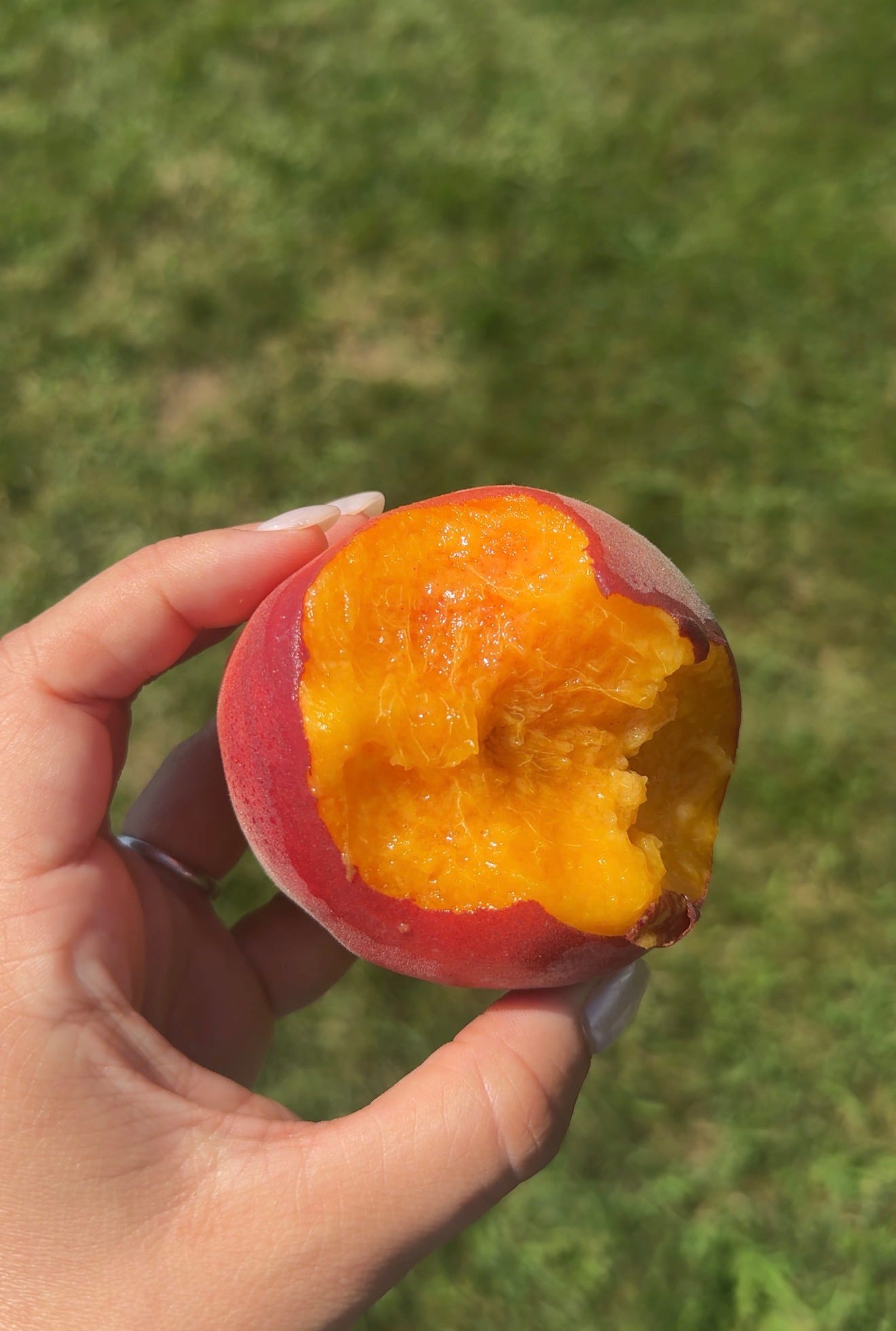
I can’t exactly remember when, but at some point my summer Martha’s Vineyard visits became defined by the hunt for Gold Bud peaches. I think we first found them at Katama General Store, 6 or 7 years ago — a mix of bewilderment and curiosity at the price tag, which back then would run you about $8 per peach. But then again, these peaches seemed perfect: packaged in crates fitted with custom inserts to prevent bruising during transit, bigger than my fist and colored deep sunset reds and oranges, so taut they seemed to be bursting at the seams with juices, and strongly perfumed. You didn’t even need to hold one to your nose, just enter the general vicinity of the crate, to smell that distinct, perfect sweet, floral peachy scent.
That first summer we saw them we took the bait. We bought them. And we ate them. Almost daring the peach to be disappointing so we could gawk at what a scam it was and roll our eyes the next time we saw some group of suckers buy the expensive, beautiful peaches.
But we couldn’t do that because what we tasted was absolute perfection. Each and every one: perfectly ripe, with flesh almost custardy– the texture resembling the creaminess of a mango, never mealy or stringy, and never hard or dry or ‘wooly’ in patches near the pit (I run into this issue often with the peaches I buy locally). And the flavor … the FLAVOR. Concentrated sweet and jammy but balanced with enough acidity to make it succulent and refreshing and not just a sugar bomb. And ridiculously juicy, leaving you with no choice but to slurp after taking a bite or be left with a steady stream of juices down your chin.
Every year since we’ve looked forward to these perfect peaches, which I’ve only ever seen sold at select farmstands on Martha’s Vineyard.
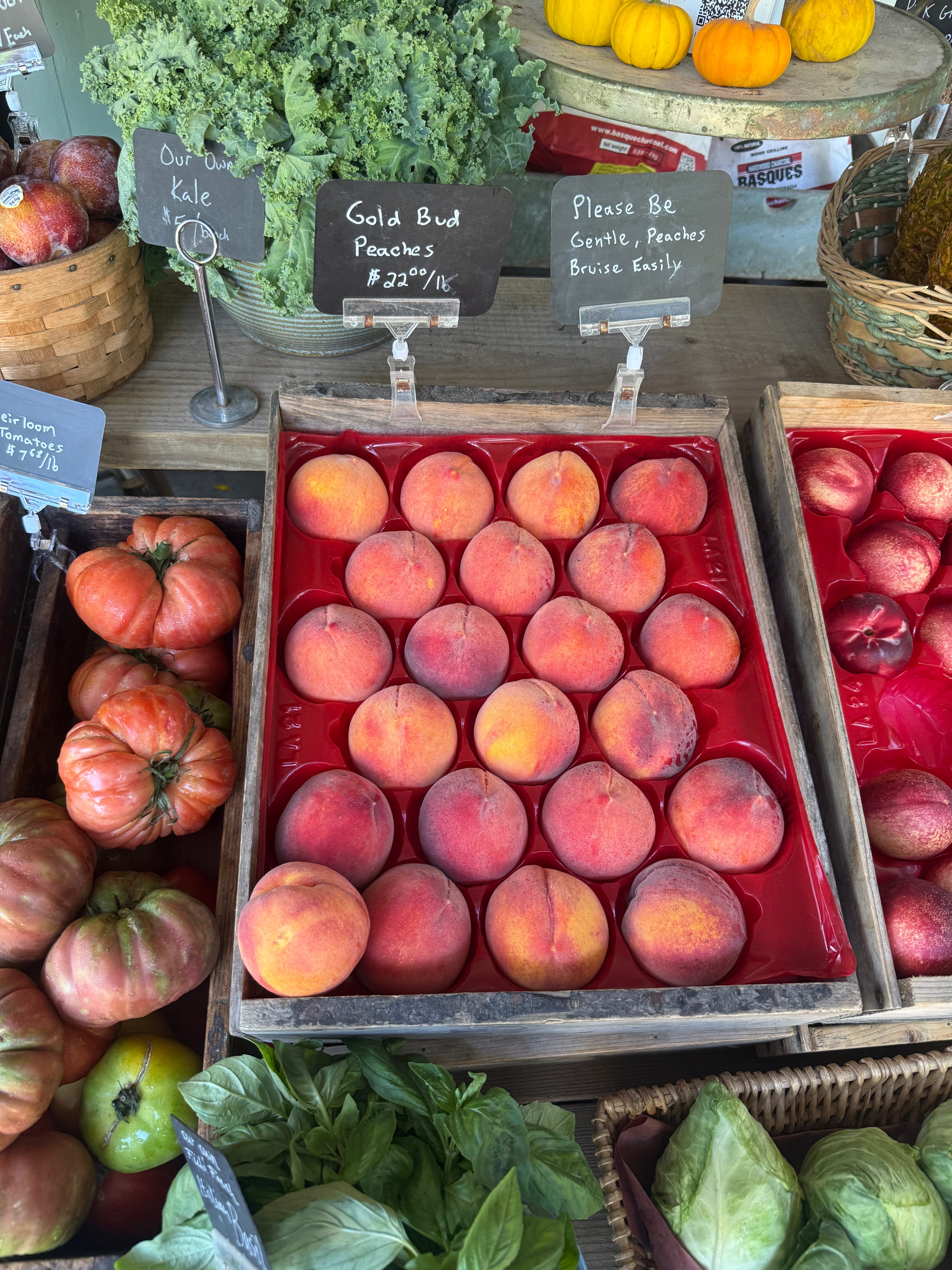
As it turns out, these perfect peaches are grown in Placerville, California on Gold Bud Farms. They’re advertised as “mountain grown fruit” and are claimed superior for a number of reasons (these are all pulled from their site):
grown in decades old orchards on heritage trees (they propagate new plantings with trimmings from old trees)
hand pruned/ thinned trees (for quality selection)
grown at mountain elevation (later growing season and cooler nights) yielding peaches with higher sugar levels
harvested daily at peak ripeness (aka tree ripened) then hand grated and sorted
efficient delivery process with fruit often going from tree to countertop in 48 hours
As a chef, discovering produce of near perfect quality (texture, size, ripeness, AND flavor) with year after year consistency is quite exciting. Peaches especially are finicky: a great peach tastes extraordinary but a bad peach is not even the same species. I’ve never understood why I’ve only ever seen Gold Bud peaches sold on this small New England Island, on the opposite coast of where they’re grown. And I’ve never understood why I never really hear anyone talk about them.
A quick google search on these peaches yields similarly sparse results. There’s a feature in the Vineyard Gazette from 4 years ago (where the peach serves as a metaphor for the island), and a piece on Serious Eats from 8 years ago where the writer agrees that Gold Bud peaches are in fact the best he’s ever eaten (technically they’re tied with Honey Crisp peaches from Honey Crisp Farms outside of Fresno, though this farm no longer exists). He ate them on Martha’s Vineyard too.
I dug deeper, and found that Vogue’s famed food writer, Jeffrey Steingarten, wrote about them nearly 2 decades ago too. In Vogue’s June 2002 issue, Steingarten Wrote “The Sweetest Thing” about his 3 year quest for the perfect peach, which he dubbed the VPP, or Vogue Peach Project.
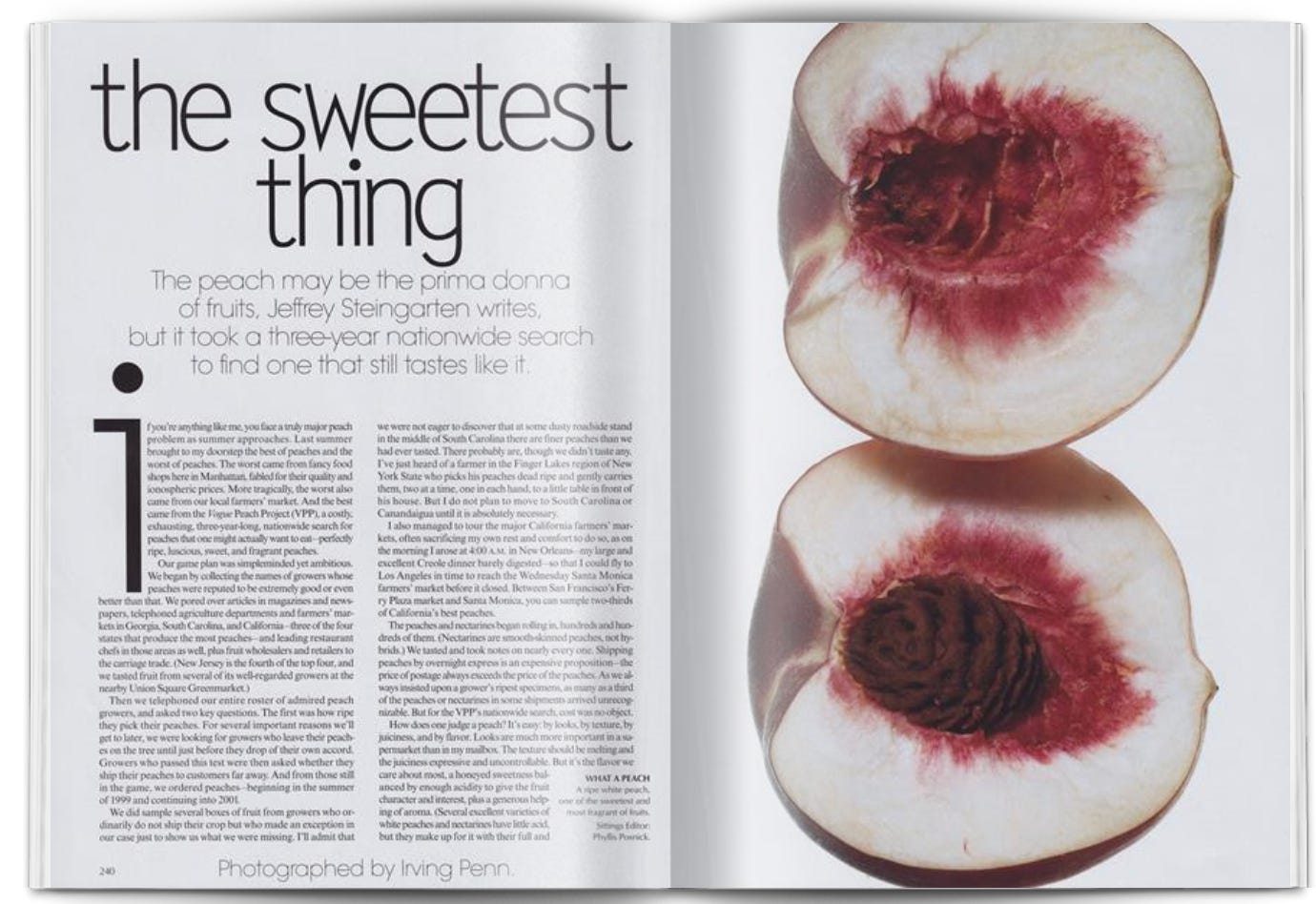
Beyond thoroughly enjoying browsing this archival early 2000’s magazine, I learned a great deal about peaches.
For one, I learned just how legitimate Gold Bud farms claims about the importance of tree ripening are. To quote Stiengarten directly:
“Peaches and nectarines picked before they are completely ripe will never ripen properly off the tree. They are hardly worth the names of peach and nectarine. Here’s what happens as a peach ripens on the tree: It becomes sweeter and sweeter; its green chlorophyll fades, and the underlying red and golden hues assert themselves, both in the background color of the skin and in the flesh; its aroma becomes ethereal and intoxicating (or, to be more down-to-earth, it smells like a peach); it softens, beginning with the shoulders (the plump flesh around the stem); it loses much of its acidity white-flesh and astringency; and it becomes voluptuous and juicy.”
Remember that much of today’s crop is harvested before the fruit is truly ripe. The hardness of a green pick allows for mechanical dumping, machine sorting, longer storage, and lengthier delivery and logistics chains. But the sacrifice is flavor, texture, nutrition, and sweetness. Tree-ripening, especially, in for the case of peaches, makes a huge difference.
I also learned that the best way to choose a peach, more than color or touch, is by its fragrance as the aroma of a peach develops with or even after its sweetness.
Steingarten concluded that “the best peaches we tasted were all from California” with Gold Bud Farms cited yet again as the source for one of his all-time favorites.


For the purposes of this investigative journalism exercise, I decided to call up Gold Bud Farms. I asked them what the connection was to Martha’s Vineyard.
“It has to do with our owner and some of the connections to wholesalers and retailers he has out there.” He had no further intel. Kinda wanted some magical story but that’s ok.
I asked if they mostly sold D to C or if there were other areas of the country with a retail market. He told me they sold to a handful of markets in the Bay area, a few in Michigan, some farmstands on Martha’s Vineyard, and one place in Brooklyn.
“Where in Brooklyn?!? I live in Brooklyn?!”
The Orchard down in South Flatbush. I have yet to visit, but if you live close there’s a chance you can get your hands on some Gold Bud peaches this summer before the season is over.
On my most recent visit to the Vineyard a few weeks ago, I kept my eyes peeled for signs perched outside farm stands announcing Gold Bud peaches for sale. When I found them (I had luck this year at North Tisbury Farms and Edgartown Meat and Fish) they were a whopping $22 a pound (the latter priced them at $12 per peach). Online at Gold Bud Farms a seasonal dozen will cost you $65/ dozen (with 2-day shipping an additional $50).
And I know I know, it feels absolutely wrong to pay that much for a single peach. And maybe it is. But I’ve never once eaten a bad Gold Bud peach. In fact, I’ve never tasted one less than perfect. And for all the shit I throw $12 at… a guaranteed perfect summer peach is not the most insane.
Steingarten concludes, “with postage and triage, you may end up paying as much as $6 or $7 a peach. Is this expensive? For one of the greatest pleasures on Earth? Not compared with that bottle of San Pellegrino you had at lunch today.” I have to agree.
I’d love to hear from you! This is not my usual style of Substack but I had a lot of fun researching and writing this piece.
chat soon,
Maddy
Sometimes I forget in addition to being an amazing chef you are also a real smarty pants!
This was a great read! my mouth is watering. I may have to send Krista on a mission to get them in Brooklyn and bring to the shore:)